
Table of Contents
Why an EPC Contractor With In-House Fabrication Changes Your Project Timeline
Most redesigns don’t happen because engineering made a mistake. They happen because a design that was technically sound on paper turned out to be difficult, slow, or expensive to actually build. That gap between design intent and shop reality is one of the most common — and most avoidable — sources of delay on industrial projects, and it’s largely a function of whether the people designing a system have any working relationship with the people fabricating it.
The Cost of a Disconnected Design-to-Fabrication Process
When engineering and fabrication are handled by separate, unaffiliated companies, design packages typically get released as finished documents and only reviewed for buildability once they land in a fabricator’s hands — often after bidding, after contracts are signed, and after schedule commitments have already been made to the client. If the fabricator flags a tolerance issue, a joint configuration that’s difficult to weld to spec, or a material substitution that would simplify the build, that feedback arrives too late to be anything but a change order.
- Redesign cycles that push back the entire project schedule
- Change orders that were avoidable if fabrication had been consulted earlier
- Quality risk when a fabricator works to the letter of a spec they had no input on
- Two separate companies each protecting their own scope when problems surface
How In-House Fabrication Closes That Gap
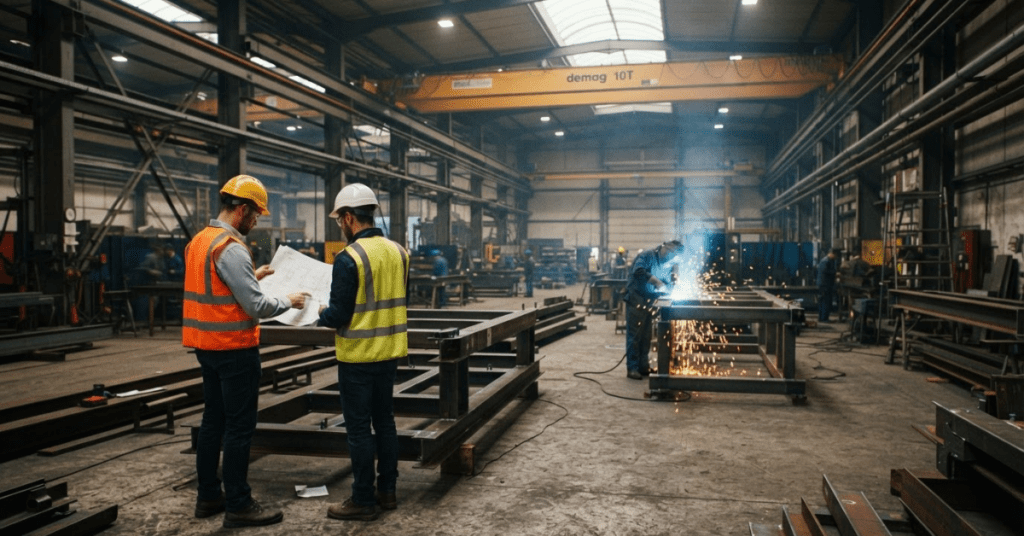
Wikota Design & Construction and Fabrication operates its own fabrication facility at 3044 Venergy Drive in Brookshire, Texas. Because engineering and fabrication sit inside the same organization, design decisions can be checked against real shop capability and constraints before a design package is ever finalized — not discovered afterward.
Design Reviews Grounded in What the Shop Can Actually Build
Engineers working alongside an in-house fabrication team have a direct line to ask, before a drawing is released, whether a specified joint configuration, material, or tolerance is practical to execute efficiently. That conversation either doesn’t happen or happens too late when fabrication is outsourced to a separate company with no stake in the engineering decision.
Certified Fabrication Standards Applied Consistently
Wikota’s fabrication work is performed to AWS D1.1 structural welding standards, with CWI-certified inspection and NACE- and NDT-certified quality review built into the process. Because the same organization controls both the design standard and the fabrication standard, there’s no ambiguity about which specification governs when a question comes up mid-build.
Fabrication and Field Construction Under One Roof
The advantage extends past the shop. Because fabrication and construction management report into the same project structure, equipment built for a specific installation is fabricated with that field environment already in mind — access constraints, lift sequencing, and site-specific tolerances are known quantities during fabrication, not surprises during installation.
Discuss Your Project
Talk to Wikota about integrating engineering and in-house fabrication on your next project.
Start the ConversationWhat This Looks Like on a Real Project
Consider a compressor skid destined for a site with tight lay-down space and a narrow installation window. An engineering firm working in isolation from fabrication might specify a design that’s structurally correct but assembled in a configuration that’s difficult to transport or set in the available footprint. With engineering and fabrication under one roof, that constraint gets factored into the design the first time, rather than surfacing as a field problem that delays startup.
This Is Not a Substitute for Fabrication Expertise — It's an Extension of It
The value of in-house fabrication as part of an EPC model isn’t that Wikota fabricates equipment — most EPC contractors either fabricate or subcontract it. The value is that fabrication and engineering are integrated closely enough to catch problems before they become schedule or budget problems. For a deeper look at Wikota’s fabrication capabilities themselves, including pressure equipment, structural steel, and process skids, see the Custom Industrial Fabrication page.
Frequently Asked Questions — In-House Fabrication
Does Wikota only fabricate equipment it also designs?
No. Wikota's fabrication facility supports both EPC projects where Wikota also handled engineering, and standalone fabrication projects where a client's own engineering team or a third party provided the design.
How does in-house fabrication affect project cost?
It typically reduces cost indirectly, by minimizing the redesign cycles and change orders that occur when a design is finalized without fabrication input, rather than through any discount on fabrication itself.
Where is Wikota's fabrication facility located?
Wikota's fabrication facility operates out of Brookshire, Texas, supporting projects across the Gulf Coast, Permian Basin, and Mid-Continent regions, with national project reach as needed.
Discuss Your Project
Talk to Wikota about integrating engineering and in-house fabrication on your next project.
Request a QuoteWikota Design & Construction and Fabrication proudly serves oil and gas, midstream, RNG, petrochemical, power generation, and helium clients across all 48 States.