Engineering & Procurement for the Energy Sector
FEED Studies · Detailed Design · Equipment Specification · Strategic Sourcing — One Team, One Workflow
Wikota’s engineering and procurement services cover the full scope of project development—from initial feasibility and front-end engineering design through detailed engineering, equipment specification, vendor evaluation, and material delivery. Our multidisciplinary engineering team works across process, mechanical, piping, structural, electrical, and instrumentation disciplines, producing the deliverables that define what gets built, how it gets built, and what it costs.
What separates Wikota from standalone engineering firms is direct integration with our fabrication shop and construction crews. The engineers who develop your design packages also coordinate with the welders who fabricate the equipment and the field teams who install it. This isn’t a referral arrangement between independent companies—it’s one organization managing engineering, procurement, fabrication, and construction under unified project controls.
We deliver engineering and procurement services for capital projects across the continental United States.
Engineering Disciplines & Deliverables
Wikota’s engineering group provides the technical foundation for every project we execute. Whether the scope calls for a front-end study to define project parameters or a full detailed design package ready for fabrication and construction, our team delivers the drawings, calculations, specifications, and data sheets that drive execution.
Front-End Engineering Design (FEED)
Before a project commits to full execution, it needs a clear technical and commercial foundation. Wikota’s FEED services establish the process basis, define major equipment, develop preliminary layouts, and produce the cost estimates and schedules that inform final investment decisions. Our FEED deliverables are structured to carry directly into detailed design without rework—because the same team executes both phases.
Process Engineering
Our process engineers develop the heat and material balances, process flow diagrams (PFDs), piping and instrumentation diagrams (P&IDs), equipment sizing calculations, and operating parameters that define system performance. We engineer process systems for applications including hydrocarbon processing, gas treatment, compression, renewable natural gas upgrading, hydrogen handling, and chemical injection—with designs validated against applicable ASME, API, and NFPA codes.
Mechanical & Pressure Vessel Design
Wikota’s mechanical engineers design pressure vessels, heat exchangers, tanks, and rotating equipment packages to meet ASME Boiler and Pressure Vessel Code (BPVC) and API standards. Because our engineering team works directly with our ASME-certified fabrication shop, designs are developed with manufacturability in mind—accounting for actual shop capabilities, weld joint configurations, material availability, and inspection access from the start.
Piping Design & Stress Analysis
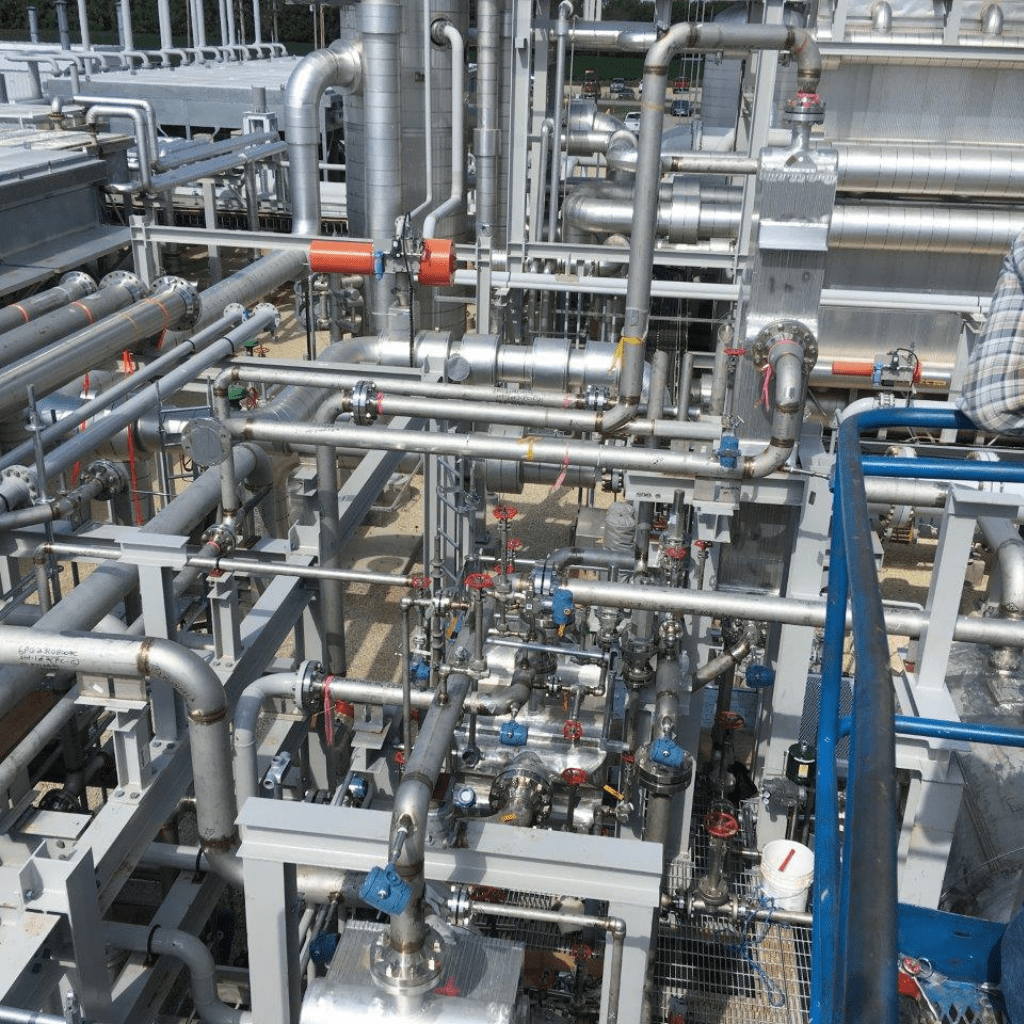
Our piping engineers produce routing studies, piping general arrangements, isometric drawings, spool drawings, and material take-offs for systems operating under high-pressure, high-temperature, and corrosive-service conditions. Pipe stress analysis ensures that thermal expansion, sustained loads, and occasional loads are addressed per ASME B31.1, B31.3, or project-specific code requirements. Designs are developed in 3D modeling environments that coordinate with all other disciplines and facilitate constructibility reviews before fabrication begins.
Structural Engineering
From equipment foundations and pipe rack structures to modular skid frames and platform access systems, Wikota’s structural engineers design steel and concrete elements that support your process installation. Structural deliverables include general arrangements, connection details, anchor bolt plans, and member sizing—designed to applicable AISC, ACI, and jurisdictional building code requirements.
Electrical & Instrumentation (E&I)
Our electrical and instrumentation engineers develop single-line diagrams, area classifications, cable schedules, instrument data sheets, loop diagrams, and control system architecture for process facilities and modular packages. E&I design addresses hazardous area classification (NEC/NFPA 70, API RP 500/505), motor control, power distribution, and instrumentation integration with client DCS or PLC systems.
3D Modeling & BIM
Wikota utilizes 3D modeling tools to develop coordinated, clash-checked design packages that reduce field rework and compress construction timelines. Our models integrate process, piping, structural, and E&I disciplines into a single environment—enabling virtual walkthroughs, constructibility reviews, and accurate material take-offs before a single piece of steel is cut.
Procurement & Supply Chain Management
Engineering deliverables are only as valuable as the equipment and materials they specify. Wikota’s procurement team converts engineering output into purchased, inspected, and delivered equipment—managing the supply chain from requisition through site delivery so that material availability drives your schedule forward rather than holding it back.
Equipment Specification & Requisition
Our engineers produce the data sheets, specifications, and requisition packages that define equipment performance, material, and compliance requirements. Because engineering and procurement operate under one roof, requisitions are technically complete before they go to market—reducing the bid clarification cycles and specification gaps that delay traditional procurement workflows.
Vendor Evaluation & Sourcing
Wikota evaluates vendors based on technical compliance, manufacturing capability, quality systems, delivery performance, and commercial terms. We maintain relationships with qualified suppliers across the energy sector’s critical equipment categories—including pressure vessels, heat exchangers, rotating equipment, valves, instrumentation, and electrical components—and leverage these relationships to secure competitive pricing and reliable delivery commitments.
Expediting & Material Tracking
Purchase orders don’t manage themselves. Our procurement team tracks every order from vendor acknowledgment through manufacturing, inspection, testing, and shipment. Expediting activities include regular vendor status updates, manufacturing milestone verification, and proactive identification of delivery risks before they impact your project schedule. Material status is reported through our project controls system, giving project managers and clients real-time visibility into the supply chain.
Inspection & Documentation
For critical equipment, Wikota coordinates source inspection at vendor facilities to verify compliance with purchase order requirements before shipment. All procurement documentation—including vendor data books, material test reports, certificates of compliance, and inspection records—is compiled, reviewed, and integrated into project turnover packages with full traceability from specification to installed component.
Engineering That Flows Directly into Fabrication and Construction
Wikota’s engineering and procurement services are part of an integrated EPC delivery model. Your design package doesn’t get handed off to a separate fabricator or contractor—it moves through one organization, with one team accountable for engineering accuracy, procurement execution, shop fabrication, and field installation.
Discuss Your Project Scope →Core EPC Services→Why Engineer and Procure with Wikota
Engineering Informed by Fabrication and Construction Reality At most engineering firms, designs are developed in isolation from the shop floor and the construction site. At Wikota, our engineers work alongside fabricators and construction managers daily. This means piping designs account for actual weld joint accessibility, vessel designs reflect real shop capabilities, and structural details anticipate field erection sequences. The result is fewer RFIs, fewer field changes, and faster installation.
Procurement Under Project—Not Purchasing—Management Wikota’s procurement function is managed by project teams, not a disconnected purchasing department. Equipment and material decisions are made by people who understand the engineering intent, the fabrication schedule, and the construction sequence—not by buyers optimizing purchase price without visibility into project impact. This project-driven approach to procurement reduces substitution risks, delivery misalignments, and documentation gaps.
Continuity from FEED Through Commissioning When the team that performs your FEED study also executes detailed design, procures equipment, fabricates in-house, and manages construction, there is no information loss between project phases. Assumptions made during front-end engineering are carried through to execution by the same people who made them. Design intent is preserved, scope gaps are minimized, and the project moves forward without the relearning curve that occurs every time work changes hands.
Right-Sized Engineering for Energy Sector Projects We’re not a 500-person engineering house quoting minimum project thresholds, and we’re not a one-discipline shop stretching beyond its depth. Wikota’s engineering team is scaled to deliver the multidisciplinary design packages that energy sector capital projects require—with senior engineer involvement on every project, direct client access to the people doing the work, and the responsiveness that large firms structurally cannot provide.
Frequently Asked Questions — Engineering & Procurement
Wikota provides multidisciplinary engineering across process, mechanical, piping, structural, electrical, and instrumentation disciplines. We also provide 3D modeling and BIM coordination, pipe stress analysis, and front-end engineering design (FEED) services. Our team is experienced with ASME, API, NFPA, AISC, ACI, and NEC code requirements as they apply to energy sector facilities and equipment.
A front-end engineering design (FEED) study establishes the technical basis, major equipment selections, preliminary layout, and cost and schedule estimates for a capital project before committing to full execution. FEED deliverables typically include process flow diagrams, preliminary P&IDs, equipment data sheets, plot plans, and a project execution plan. Wikota performs FEED studies and structures them to carry directly into detailed design—because our same engineering team executes both phases, eliminating the rework that occurs when FEED and detail design are performed by different firms.
Our procurement process begins with technically complete equipment specifications and requisition packages developed by our engineers. From there, we manage vendor evaluation and sourcing, commercial bid analysis, purchase order placement, expediting and progress tracking, source inspection coordination, and logistics through site delivery. Procurement is managed by project teams with engineering context—not a standalone purchasing department—so equipment decisions align with design intent, fabrication schedules, and construction sequencing.
Yes. We engineer new facilities from the ground up and also execute brownfield projects including facility expansions, equipment replacements, tie-ins to existing systems, and operational upgrades. Brownfield engineering requires detailed understanding of as-built conditions, operating constraints, and tie-in coordination—challenges our team addresses through field surveys, 3D scanning integration, and close coordination with operations personnel.
ecks.
Detailed engineering deliverables vary by project scope but typically include process flow diagrams (PFDs), piping and instrumentation diagrams (P&IDs), equipment data sheets, piping isometrics and spool drawings, structural general arrangements and connection details, electrical single-line diagrams, instrument data sheets and loop diagrams, 3D models, material take-offs, and equipment and material requisition packages. All deliverables are produced to project-specific standards and undergo interdisciplinary review before issue.
When engineering and procurement are managed by the same team, long-lead equipment can be identified and ordered early in the design process rather than waiting for engineering completion. Requisitions are technically complete at issue—reducing bid clarification cycles. Vendor data flows directly back into engineering models without manual reentry. And procurement schedules are coordinated with fabrication and construction timelines from the start, so material delivery aligns with when it’s actually needed. This integrated approach compresses overall project duration and reduces the schedule risk inherent in sequential, disconnected workflows.
We serve clients across oil exploration and production, natural gas extraction, midstream gathering and processing, petrochemical processing, refining, LNG, pipeline infrastructure, electric power generation, renewable energy, nuclear energy, bioenergy, renewable natural gas, hydrogen systems, energy storage, and alternative fuels.
Yes. We develop coordinated 3D models that integrate process, piping, structural, and electrical/instrumentation disciplines into a single environment. These models enable clash detection, virtual walkthroughs, constructibility reviews, and accurate material take-offs. For projects that involve our fabrication shop, the 3D model also serves as a direct reference for shop production—ensuring dimensional consistency between design and fabricated components.
Contact our team at info@wikotadc.com or (281) 833-8130 to discuss your project scope, engineering requirements, and timeline. Whether you need a standalone FEED study, a full detailed engineering package, integrated procurement support, or turnkey EPC delivery, we’ll work with you to define the right scope of services and develop a proposal that addresses your technical, commercial, and schedule requirements.
Ready to Start Engineering?
From FEED studies and multidisciplinary detailed design to equipment procurement and supply chain management, Wikota’s integrated engineering and procurement services give your energy project the technical foundation and material delivery it needs to move from concept to operation. Let’s discuss your requirements.
Start an Engineering Conversation →View All Core EPC Services →